
 By
By 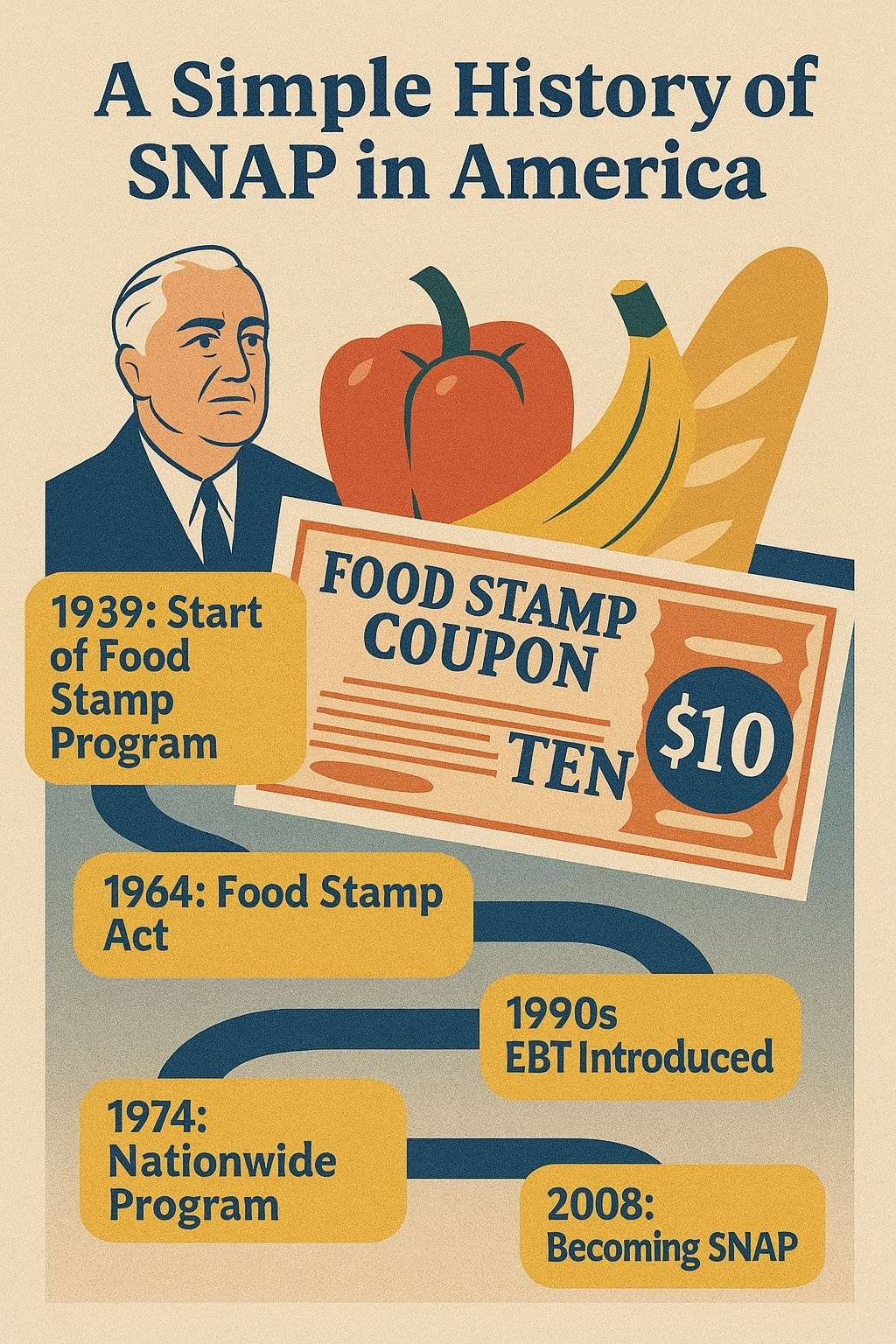
The Supplemental Nutrition Assistance Program (SNAP), once known simply as “food stamps,” is one of the most important safety nets in the United States. Today, it helps more than 40 million Americans put food on the table each month. But SNAP didn’t appear overnight—it grew out of the struggles of the Great Depression, was reshaped during the War on Poverty, and has continued to evolve with each new era of American life.
This post takes a closer look at how SNAP began, how it has changed, and why it remains such a vital part of the nation’s fight against hunger.
1930s: A Depression‑Era Experiment
In 1939, President Franklin D. Roosevelt’s administration launched the first Food Stamp Program. The idea was simple but powerful: families could buy orange stamps to purchase everyday groceries, and for every dollar spent, they received blue stamps to buy surplus farm goods. This system not only helped struggling households but also supported farmers who were producing more than the market could handle.
Although the program ended in 1943 as the economy recovered from World War II, it set the stage for future food assistance efforts.
1960s: From Pilot to Policy
Two decades later, President John F. Kennedy revived the concept with pilot programs in select communities. These experiments modernized the food stamp idea and proved that it could work on a larger scale.
In 1964, President Lyndon B. Johnson signed the Food Stamp Act, making the program permanent as part of his “War on Poverty.” For the first time, food assistance became a cornerstone of federal anti‑poverty policy.
1970s: Going Nationwide
By 1974, the Food Stamp Program had expanded to every state. Reforms during this decade standardized eligibility rules and benefits, ensuring that families across the country had more equal access to assistance.
This was also the era when the program became a household name—millions of Americans relied on food stamps as part of their daily survival.
1980s: Cuts, Controversy, and Awareness
The 1980s brought budget cuts and political debates over the size of the program. Critics argued about cost and dependency, while advocates pointed to rising hunger and poverty. Despite the tension, the program endured, and public awareness of food insecurity grew.
1990s–2000s: Modernization and EBT Cards
The 1990s marked a major shift: paper food stamps were gradually replaced with Electronic Benefit Transfer (EBT) cards. This change reduced fraud, streamlined the system, and made the experience less stigmatizing for families.
By the early 2000s, EBT cards were the norm nationwide, and the program had become more efficient and accessible.
2008: A New Name, A Broader Mission
In 2008, the Food Stamp Program officially became the Supplemental Nutrition Assistance Program (SNAP). The new name emphasized nutrition and dignity, moving away from the stigma of “stamps” and highlighting the program’s role in promoting healthier food choices.
Today: A Lifeline for Millions
SNAP now serves over 40 million Americans each month. Benefits are loaded onto EBT cards and can be used at grocery stores, farmers markets, and even some online retailers. The program also adapts during crises—expanding during the COVID‑19 pandemic, for example, to help families weather economic shocks.
SNAP remains the largest federal food assistance program, balancing three goals:
- Supporting families in need by ensuring access to food.
- Stabilizing the economy by boosting local businesses during downturns.
- Adapting to crises to protect vulnerable communities.
From Depression‑era coupons to today’s digital EBT cards, SNAP has grown into a cornerstone of America’s fight against hunger. Its history reflects the nation’s ongoing struggle to balance economic policy, social justice, and human dignity.
As debates about poverty, food insecurity, and government support continue, SNAP’s story reminds us that food assistance is not just about meals—it’s about resilience, opportunity, and the belief that no one in America should go hungry.