

 By
By 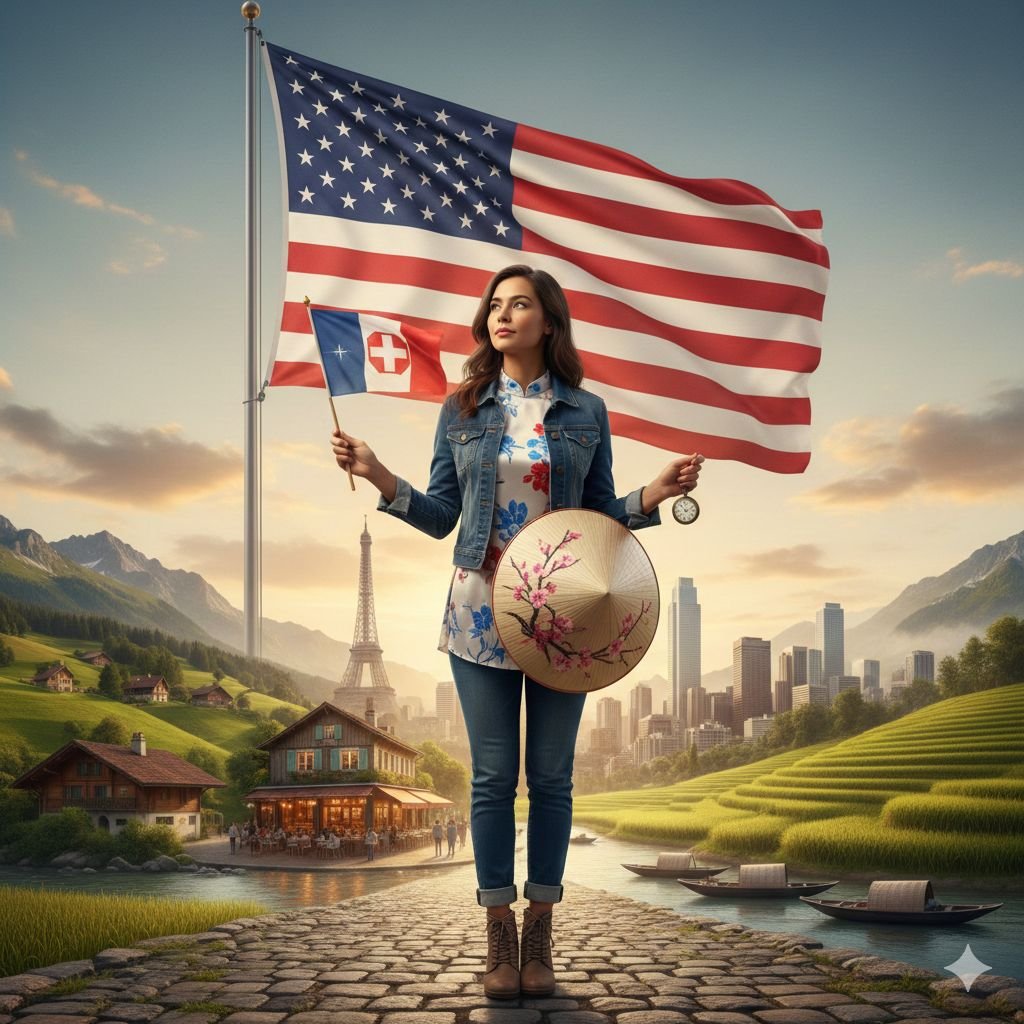
But loving the show doesn’t mean I buy into the fantasy anymore.
Not as an American.
And definitely not as someone whose family lived the complicated truth behind that postcard.
The American Abroad Fantasy Doesn’t Hit the Same
There was a time when shows like Emily in Paris made me want to pack a suitcase and wander cobblestone streets. But the world has shifted. Being an American abroad doesn’t feel carefree or charming anymore. It feels… watched. Judged. Sometimes unwelcome.
The show sells a version of France where Americans are quirky, harmless, and easily forgiven. Real life doesn’t always extend that grace.
And for me, the disconnect runs deeper than modern politics or cultural tension. It’s generational.
A Relationship Already Strained by History — and Strained Again Today
If we’re being honest, Emily in Paris arrives at a moment when the real‑world relationship between the United States and France is already tense. And that tension isn’t new — it’s part of a long, uneven history between the two countries. There have been moments of deep alliance, but also moments of open conflict: the Quasi‑War of the 1790s, the diplomatic meltdown of the XYZ Affair, France’s withdrawal from NATO’s command structure in the 1960s, and the bitter divide over the Iraq War in 2003. Even today, disagreements over trade, climate policy, and public political remarks continue to create friction between Washington and Paris. So when a show paints France as effortlessly charmed by an American newcomer, it feels out of sync with the reality that this is one of the most strained periods in modern Franco‑American relations — socially, politically, and culturally.
My Family’s French–Vietnamese Story Lives Under the Surface
My grandmother wrote Saigon Is Burning, a book that documents the French–Vietnamese experience from the inside — not the romanticized version, but the lived one.
My family is Swiss French and Vietnamese.
My great‑grandmother was French and Vietnamese.
We were what the French called Métis — mixed.
And in colonial Vietnam, that wasn’t a poetic descriptor. It was a category. A limitation. A reminder.
Without a French last name, you couldn’t get certain jobs.
You couldn’t access certain schools.
You couldn’t move freely in the world the way Emily Cooper does with her bright wardrobe and brighter optimism.
Some of my relatives had to marry or be adopted just to gain a French surname — not for love, but for survival. And even then, acceptance was conditional. You were never fully French. Never fully Vietnamese. Always something in between.
That kind of history doesn’t disappear. It echoes.
I carry Vietnamese, French, Swiss, and American blood — and I carry it proudly. My grandmother escaped Vietnam before the war, bilingual and brave, her story folded into mine. The French influence runs through our food and our future; in every pastry, there’s a softness and a strength that belong to both worlds. Vietnamese desserts are a quiet miracle — delicate, defiant, and born from history. Without France, I don’t know where my family would be. But I know this: we are here. And we are beautiful.
The Show’s Paris Isn’t My Family’s Paris
So when I watch Emily in Paris, I enjoy it — truly. But I also feel the gap between the fantasy and the truth my family lived through.
The show’s Paris is glossy, forgiving, and uncomplicated.
My family’s Paris — the one that shaped our identity — was layered with hierarchy, exclusion, and the quiet ache of never belonging anywhere completely.
It’s hard to unsee that once you know it.
Loving the Show Doesn’t Mean Ignoring the Truth
I can adore the fashion, the humor, the escapism. I can appreciate the joy of a show that doesn’t pretend to be anything other than entertainment.
But I also carry the stories of my grandmother, my great‑grandmother, and the generations who navigated a France that didn’t look like a postcard.
So no — Emily in Paris doesn’t make me want to visit France anymore.
It makes me think about identity, belonging, and the way history lingers in the background of even the brightest scenes.
And maybe that’s its own kind of clarity.
Emily in Paris est charmante — mais elle ne me donne plus envie de visiter la France
Il y a quelque chose d’indéniablement délicieux dans Emily in Paris. Les couleurs, les vêtements, les flirtations, l’éclat assumé — c’est une série qui sait exactement ce qu’elle est et qui refuse de s’excuser d’être joyeuse. J’aime ça. J’aime l’évasion, la mode, la façon dont Paris brille comme une carte postale soigneusement composée.
Mais aimer la série ne veut pas dire que j’achète encore le fantasme.
Pas en tant qu’Américaine.
Et certainement pas en tant que personne dont la famille a vécu la vérité compliquée derrière cette carte postale.
Le fantasme de l’Américaine à l’étranger ne résonne plus
Il fut un temps où des séries comme Emily in Paris me donnaient envie de faire une valise et de marcher sur des rues pavées. Mais le monde a changé. Être Américaine à l’étranger ne semble plus insouciant ou charmant. Cela semble… observé. Jugé. Parfois indésirable.
La série vend une version de la France où les Américains sont excentriques, inoffensifs et facilement pardonnés. La vraie vie n’offre pas toujours cette indulgence.
Et pour moi, le décalage va plus loin que la politique moderne ou les tensions culturelles. Il est générationnel.
Une relation déjà tendue par l’histoire — et encore plus aujourd’hui
Soyons honnêtes : Emily in Paris arrive à un moment où la relation réelle entre les États‑Unis et la France est déjà fragile. Et cette fragilité n’est pas nouvelle — elle fait partie d’une longue histoire irrégulière entre les deux pays. Il y a eu des alliances profondes, mais aussi des conflits ouverts : la quasi‑guerre des années 1790, le scandale diplomatique de l’Affaire XYZ, le retrait de la France du commandement intégré de l’OTAN dans les années 1960, et la fracture amère autour de la guerre en Irak en 2003. Aujourd’hui encore, les désaccords sur le commerce, le climat et les déclarations publiques entretiennent les tensions. Alors quand une série montre une France facilement charmée par une Américaine, cela sonne faux — surtout dans l’un des moments les plus tendus des relations franco‑américaines modernes.
L’histoire franco‑vietnamienne de ma famille vit sous la surface
Ma grand‑mère a écrit Saigon Is Burning, un livre qui raconte l’expérience franco‑vietnamienne de l’intérieur — pas la version romancée, mais la version vécue.
Ma famille est suisse, française et vietnamienne.
Mon arrière‑grand‑mère était française et vietnamienne.
Nous étions ce que les Français appelaient Métis — métissés.
Et dans le Vietnam colonial, ce n’était pas un mot poétique. C’était une catégorie. Une limite. Un rappel.
Sans nom de famille français, vous ne pouviez pas obtenir certains emplois.
Vous n’aviez pas accès à certaines écoles.
Vous ne pouviez pas circuler librement comme Emily Cooper avec sa garde‑robe lumineuse et son optimisme encore plus éclatant.
Certaines de mes parentes ont dû se marier ou être adoptées simplement pour obtenir un nom français — non pas par amour, mais pour survivre. Et même ainsi, l’acceptation restait conditionnelle. Jamais complètement française. Jamais complètement vietnamienne. Toujours entre les deux.
Ce genre d’histoire ne disparaît pas. Il résonne.
La Douceur de la Survie
Je porte en moi le sang vietnamien, français, suisse et américain — et j’en suis fière. Ma grand‑mère a quitté le Vietnam avant la guerre, bilingue et courageuse, son histoire tissée dans la mienne. L’influence française traverse notre cuisine et notre destin; dans chaque pâtisserie, il y a une douceur et une force qui appartiennent aux deux mondes. Les desserts vietnamiens sont un miracle discret — délicats, résistants, nés de l’histoire. Sans la France, je ne sais pas où ma famille serait aujourd’hui. Mais je sais ceci : nous sommes là. Et nous sommes magnifiques.
Le Paris de la série n’est pas le Paris de ma famille
Alors quand je regarde Emily in Paris, j’apprécie — vraiment. Mais je ressens aussi l’écart entre le fantasme et la vérité que ma famille a vécue.
Le Paris de la série est brillant, indulgent, sans complications.
Le Paris de ma famille — celui qui a façonné notre identité — était fait de hiérarchie, d’exclusion, et de cette douleur silencieuse de n’appartenir complètement à aucun monde.
Une fois que vous le savez, il est difficile de l’oublier.
Aimer la série ne veut pas dire ignorer la vérité
Je peux adorer la mode, l’humour, l’évasion. Je peux apprécier la joie d’une série qui ne prétend être rien d’autre qu’un divertissement.
Mais je porte aussi les histoires de ma grand‑mère, de mon arrière‑grand‑mère, et des générations qui ont navigué dans une France qui ne ressemblait pas à une carte postale.
Alors non — Emily in Paris ne me donne plus envie de visiter la France.
Elle me fait réfléchir à l’identité, à l’appartenance, et à la façon dont l’histoire se glisse dans les scènes les plus lumineuses.
Et peut‑être que c’est une autre forme de clarté.
Emily in Paris thật dễ thương — nhưng không còn khiến tôi muốn đến Pháp nữa
Có điều gì đó thật cuốn hút trong Emily in Paris. Màu sắc, trang phục, những rung động lãng mạn, sự lấp lánh không hề che giấu — bộ phim biết chính xác nó là gì và không xin lỗi vì niềm vui mà nó mang lại. Tôi thích điều đó. Tôi thích sự thoát ly, thời trang, và cách Paris tỏa sáng như một tấm bưu thiếp được sắp đặt hoàn hảo.
Nhưng yêu bộ phim không có nghĩa là tôi còn tin vào giấc mơ ấy.
Không phải với tư cách một người Mỹ.
Và càng không phải với tư cách một người mang trong mình câu chuyện phức tạp mà gia đình tôi đã sống.
Giấc mơ “người Mỹ ở nước ngoài” không còn đúng nữa
Đã có lúc những bộ phim như Emily in Paris khiến tôi muốn xách vali và đi dạo trên những con đường lát đá. Nhưng thế giới đã thay đổi. Là người Mỹ ở nước ngoài không còn cảm giác vô tư hay dễ thương nữa. Nó cảm giác… bị quan sát. Bị phán xét. Đôi khi không được chào đón.
Bộ phim bán một hình ảnh nước Pháp nơi người Mỹ được xem là dễ thương, vô hại và dễ dàng được tha thứ. Ngoài đời, điều đó không phải lúc nào cũng đúng.
Và với tôi, sự lệch pha này sâu hơn cả chính trị hay văn hóa hiện đại. Nó là chuyện của nhiều thế hệ.
Một mối quan hệ vốn đã căng thẳng — và càng căng thẳng hơn ngày nay
Thực tế mà nói, Emily in Paris xuất hiện vào thời điểm quan hệ giữa Hoa Kỳ và Pháp vốn đã mong manh. Và điều này không mới — nó là một phần của lịch sử dài đầy thăng trầm giữa hai quốc gia. Đã có những thời kỳ đồng minh sâu sắc, nhưng cũng có những xung đột rõ rệt: cuộc “chiến tranh gần như” vào những năm 1790, vụ bê bối ngoại giao XYZ, việc Pháp rút khỏi bộ chỉ huy NATO vào thập niên 1960, và sự chia rẽ cay đắng về chiến tranh Iraq năm 2003. Ngày nay, những bất đồng về thương mại, khí hậu và phát ngôn chính trị tiếp tục tạo ra căng thẳng. Vì vậy, khi bộ phim mô tả một nước Pháp dễ dàng bị một cô gái Mỹ làm xiêu lòng, điều đó nghe thật xa rời thực tế — nhất là trong giai đoạn căng thẳng nhất của quan hệ Pháp–Mỹ hiện đại.
Câu chuyện Pháp–Việt của gia đình tôi luôn hiện diện phía sau
Bà ngoại tôi viết Saigon Is Burning, một cuốn sách kể lại trải nghiệm Pháp–Việt từ bên trong — không phải phiên bản lãng mạn, mà là phiên bản thật.
Gia đình tôi là sự hòa trộn giữa Thụy Sĩ, Pháp và Việt Nam.
Cụ tôi là người Pháp và Việt.
Chúng tôi là Métis — con lai.
Và trong thời Pháp thuộc, đó không phải là một từ đẹp. Nó là một phân loại. Một giới hạn. Một lời nhắc nhở.
Không có họ Pháp, bạn không thể có những công việc nhất định.
Bạn không thể vào những trường học nhất định.
Bạn không thể tự do đi lại như Emily Cooper với tủ đồ rực rỡ và sự lạc quan vô tận.
Một số người trong gia đình tôi phải kết hôn hoặc được nhận làm con nuôi chỉ để có được họ Pháp — không phải vì tình yêu, mà vì sự sống còn. Và ngay cả khi có họ Pháp, sự chấp nhận vẫn luôn có điều kiện. Không bao giờ hoàn toàn là người Pháp. Không bao giờ hoàn toàn là người Việt. Luôn ở giữa.
Những câu chuyện như vậy không biến mất. Chúng vang vọng.
Sự Ngọt Ngào của Sự Sống Còn
Tôi mang trong mình dòng máu Việt Nam, Pháp, Thụy Sĩ và Mỹ — và tôi tự hào về điều đó. Bà ngoại tôi rời Việt Nam trước chiến tranh, song ngữ và can đảm, câu chuyện của bà hòa vào câu chuyện của tôi. Ảnh hưởng của Pháp chảy trong ẩm thực và tương lai của gia đình tôi; trong mỗi chiếc bánh ngọt là sự mềm mại và sức mạnh của hai thế giới. Bánh ngọt Việt Nam là một điều kỳ diệu lặng lẽ — tinh tế, kiên cường, sinh ra từ lịch sử. Nếu không có nước Pháp, tôi không biết gia đình mình sẽ ở đâu. Nhưng tôi biết điều này: chúng tôi vẫn ở đây. Và chúng tôi thật đẹp.
Paris trong phim không phải Paris của gia đình tôi
Vì vậy, khi tôi xem Emily in Paris, tôi thật