
 By
By  By Hope-Elena Sardella-Claunch, 2019
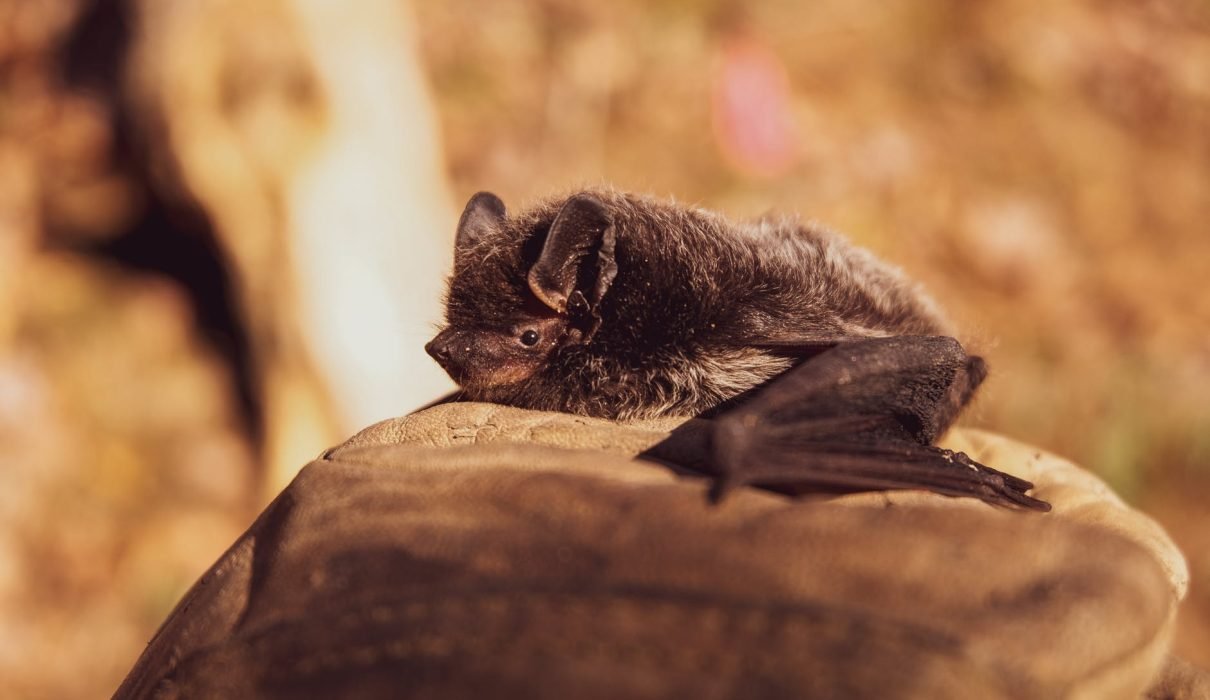
The Eastern Red Bat (Lasiurus borealis) is one of Oklahoma’s most distinctive and quietly vulnerable wildlife residents. Unlike most bat species, it lives and travels independently — or alongside its pups — relying on the canopies of large-leafed trees and dense foliage for shelter rather than caves or colonies. Taxonomically, it belongs to the family Vespertilionidae, Genus Lasiurus, Species Borealis. According to the Oklahoma Department of Wildlife Conservation, the Eastern Red Bat has an estimated wingspan of eleven to thirteen inches, with a torso length ranging from 3.5 to 4.25 inches (Eastern Red Bat, n.d., p. 13).
One of the more striking features of this species is how visibly different the males and females appear. Males display vivid fur ranging from bright orange-brown to deep red-brown. Females, while sharing similar red tones, are often distinguished by distinctive white tips at the ends of their hair, giving them the appearance of a frosted coat. These visual markers are more than cosmetic — the ability to identify individual Eastern Red Bats by sex and coat pattern is a genuine asset to conservation monitoring in the field.
Despite these identifying characteristics, the Eastern Red Bat remains poorly understood within Oklahoma’s broader conservation landscape. There is ongoing scholarly conflict about whether its current conservation status accurately reflects the threats it faces, or whether economic interests and data gaps have allowed those threats to go underaddressed. In contrast to the prevailing assumption that the ERB is adequately protected, I argue that a multi-pronged strategy — one that incorporates public participation at the county level and directly confronts economic precedence — is necessary to stabilize bat populations across the state.
MAJOR THREAT ONE: DEFORESTATION AND HABITAT LOSS IUCN Threat Category 5.3 — Logging & Wood Harvesting
The Eastern Red Bat is currently classified as Least Concern (LC) on the IUCN Red List. However, NatureServe Explorer’s (2016) contradictory analysis rates its global conservation status as ranging from high to medium concern, citing a rapid decline in the forest cover the ERB depends on for roosting. This discrepancy matters — it suggests the current classification may not fully account for habitat loss driven by deforestation.
A study by Mager and Nelson (2001) tracked twelve individual Eastern Red Bats using radio transmitters and found that full-grown trees, leaf litter, thick grasslands, and even residential rooftops served as critical habitat. Their research documented that in the corn belt region of the Midwest, where forests have been heavily fragmented, urban trees have become essential roosting habitat for red bats. This pattern of displacement — from rural forests to urban environments — places the ERB in closer proximity to human activity and the hazards that come with it.
As urbanization continues to accelerate, the removal of urban trees compounds the problem. Liu, He, and Wu (2016) found that continued urban development results in increased habitat loss and fragmentation, further narrowing the available landscape for species already in ecological retreat. Conservation of both rural and urban trees must therefore be treated as a foundational milestone in any serious effort to protect the Eastern Red Bat.
MAJOR THREAT TWO: WIND FARM MORTALITY IUCN Threat Category 3.3 — Renewable Energy
The expansion of wind energy infrastructure across Oklahoma presents a significant and underacknowledged threat to the Eastern Red Bat. A forensic investigation by Rollins, Meyerholz, Johnson, Capparella, and Loew (2012) examined whether bat deaths near wind farms were caused by pulmonary barotrauma — a condition triggered by rapid pressure changes — or by direct physical impact with turbine blades. Their two-part study found only marginal evidence to confirm barotrauma as a primary cause, though they cautioned against dismissing it entirely. More significantly, the study determined that for every 190 bats near wind farms, 262 fatality events were recorded — meaning mortality rates exceed the observable population in a given area, pointing to a severe and ongoing population drain.
Rollins et al. (2012) concluded that the findings underscored an urgent need for better monitoring strategies and scientific validation methods to substantiate the scale of bat mortality near wind farms. Without this data, economic interests in renewable energy will continue to take precedence over the biodiversity consequences for species like the ERB.
MAJOR THREAT THREE: INACCURATE DATA AND UNKNOWN POPULATION STATISTICS IUCN Threat Category 12.1 — Other Threat
Perhaps the most complicated challenge in protecting the Eastern Red Bat is that the numbers used to assess its conservation status may not reflect reality. In a personal interview with Bruce “Radar” Taylor, founder of the Foundation for Environmental and Wildlife Education, Research, and Rehab (FEWERR) in Tulsa, Mr. Taylor explained the limitations of current survey methodology:
“They do a mist netting to do their counts and that is one location in a whole state to set their endangered categories. They also calculate migrations and many other parameters, but I think there is a lot of unknowns in their calculations.” — B.R. Taylor, personal communication, June 7, 2019
This means statewide ERB population assessments are being drawn from a single monitoring site — a sample size far too small to represent the species’ full range. Mr. Taylor also provided important ecological context about the ERB’s reproduction and rescue patterns:
“Red bats on average have five pups, unlike other bats. It’s also the reason they end up in rehab — they live in hedges and other bushes, and when the gardener trims them, they grab their pups and try to fly. If it’s more than two weeks, their pups are too big and they plop on the ground, then people find them and think they are injured. Bats leave their young to forage for food and return, but if frightened, they will look for a new location and grab the pups they can.” — B.R. Taylor, personal communication, June 7, 2019
According to FEWERR, the Eastern Red Bat is among the most frequently rescued bat species at the Tulsa rehabilitation center (“Oklahoma Species of Bats,” n.d.). Yet the circumstances that lead to these rescues remain poorly documented in the scientific literature. Mr. Taylor’s firsthand knowledge fills a critical gap — and illustrates why grassroots, community-level data collection is not supplementary to conservation efforts, but essential to them.
CONSERVATION PLAN FOR THE EASTERN RED BAT
This plan draws on cognitive psychology and social science as driving frameworks — recognizing that scientific conservation goals cannot be achieved without sustained public engagement (Kareiva, Groves, Marvier, & Hulme, 2014, p. 1145).
The centerpiece of this proposal is a statewide “Bat Monitor” program, modeled after Blue Thumb’s Water Monitor initiative, in which trained community volunteers are recruited in each county of Oklahoma. Bat Monitors would be responsible for community outreach, bat rescue coordination, and transportation of injured bats to the FEWERR rehabilitation clinic in Tulsa. While mist netting requires permits, Bat Monitors would submit field sightings to a dedicated online application — creating a distributed data collection network that meaningfully expands the ERB’s observational record statewide. A reasonable application fee would help fund rehabilitation and testing costs.
To address habitat loss, Bat Monitors would also build and install bat houses at bi-annual community events. Each registered bat house would require scheduled maintenance and periodic site visits. Residents who host bat houses could earn the designation of “Bat Parents” and, where possible, receive a tax incentive in exchange for allowing camera surveillance of the structure for research purposes.
On the issue of wind farms, I recommend that public scoping processes for all wind energy operations in Oklahoma be reevaluated to identify zones requiring regular bat population monitoring. Structural safety measures should be implemented to reduce bat access to active turbine areas, and new policy frameworks should hold wind energy operators to a defined standard of environmental responsibility for bat mortality on their properties.
LOCAL PARTNERS AND STAKEHOLDERS
One of the most compelling arguments for public investment in bat conservation is economic. Bats provide invaluable pest control for Oklahoma’s agricultural sector by consuming plant-eating insects that would otherwise require chemical pesticides. Kasso and Balakrishnan (2013) estimated that bats save the agricultural industry between four and fifty-three billion dollars annually through natural insect predation. Agricultural stakeholders across Oklahoma have a direct financial incentive to support bat conservation and should be actively lobbied to sponsor community events, fund Bat Monitor programs, and offset costs associated with ERB habitat development.
CONCLUSION
The Eastern Red Bat has earned a title it never asked for: the Neighbor Bat. It has adapted, largely out of necessity, to live alongside humans in urban trees, residential shrubs, and backyard foliage. But proximity to humans is not the same as protection from them. Deforestation, wind farm mortality, and inaccurate population data have each contributed to a conservation gap that the ERB’s current Least Concern status does not adequately address.
A statewide, community-driven conservation program — combining citizen science through Bat Monitors, habitat restoration through bat houses, agricultural partnerships, and wind energy policy advocacy — offers a realistic and scalable path forward. By integrating social science and cognitive psychology into the conservation framework, Oklahoma has the opportunity to build something lasting: a public that understands, values, and actively protects one of its most overlooked wild neighbors.
REFERENCES
Arroyo-Cabrales, J., Miller, B., Reid, F., Cuarón, A.D. & de Grammont, P.C. (2016). Lasiurus borealis. The IUCN Red List of Threatened Species 2016. http://dx.doi.org/10.2305/IUCN.UK.2016-1.RLTS.T11347A22121017.en
Eastern Red Bat. (n.d.). Oklahoma Department of Wildlife Conservation.
IUCN Threat Category Definitions. (n.d.). The International Union for Conservation of Nature. Retrieved from https://wildlife.state.nh.us/wildlife/documents/wap/appendixf-iucncategories.pdf
Kareiva, P., Groves, C., Marvier, M., & Hulme, P.E. (2014). The evolving linkage between conservation science and practice at The Nature Conservancy. Journal of Applied Ecology, 51(5), 1137–1147. https://doi.org/10.1111/1365-2664.12259
Kasso, M. & Balakrishnan, M. (2013). Ecological and economic importance of bats (Order Chiroptera). ISRN Biodiversity, 2013, Article ID 187415. https://doi.org/10.1155/2013/187415
Lindenmayer, D. & Hunter, M. (2010). Some guiding concepts for conservation biology. Conservation Biology, 24(6), 1459–1468. http://dx.doi.org/10.1111/j.1523-1739.2010.01544.x
Liu, Y., He, Q., & Wu, J. (2016). The relationship between habitat loss and fragmentation during urbanization. Public Library of Science, 11(4). https://www.plos.org/
Mager, K.J. & Nelson, T.A. (2001). Roost-site selection by Eastern Red Bats (Lasiurus borealis). The American Midland Naturalist, 145(1), 120–126. https://doi.org/10.1674/0003-0031(2001)145[0120:RSSBER]2.0.CO;2
NatureServe Explorer. (2016). Lasiurus borealis — Eastern Red Bat. Retrieved from https://explorer.natureserve.org/
Oklahoma Species of Bat. (n.d.). Foundation for Environmental & Wildlife Education, Research & Rehab (FEWERR).
Rollins, K.E., Meyerholz, D.K., Johnson, G.D., Capparella, A.P., & Loew, S.S. (2012). A forensic investigation into the etiology of bat mortality at a wind farm. Veterinary Pathology, 49(2), 362–371. https://doi.org/10.1177/0300985812436745
University of Tennessee at Knoxville. (2011, April 1). Economic importance of bats in the ‘billions a year’ range. ScienceDaily. www.sciencedaily.com/releases/2011/03/110331142212.htm