
 By
By 
When I met Heather D’Aoust, she wasn’t a headline. She wasn’t a case file. She wasn’t the girl who killed her mother. She was simply another teenager in San Diego’s juvenile hall — frightened, exhausted, and trying to understand how her life had unraveled so quickly.
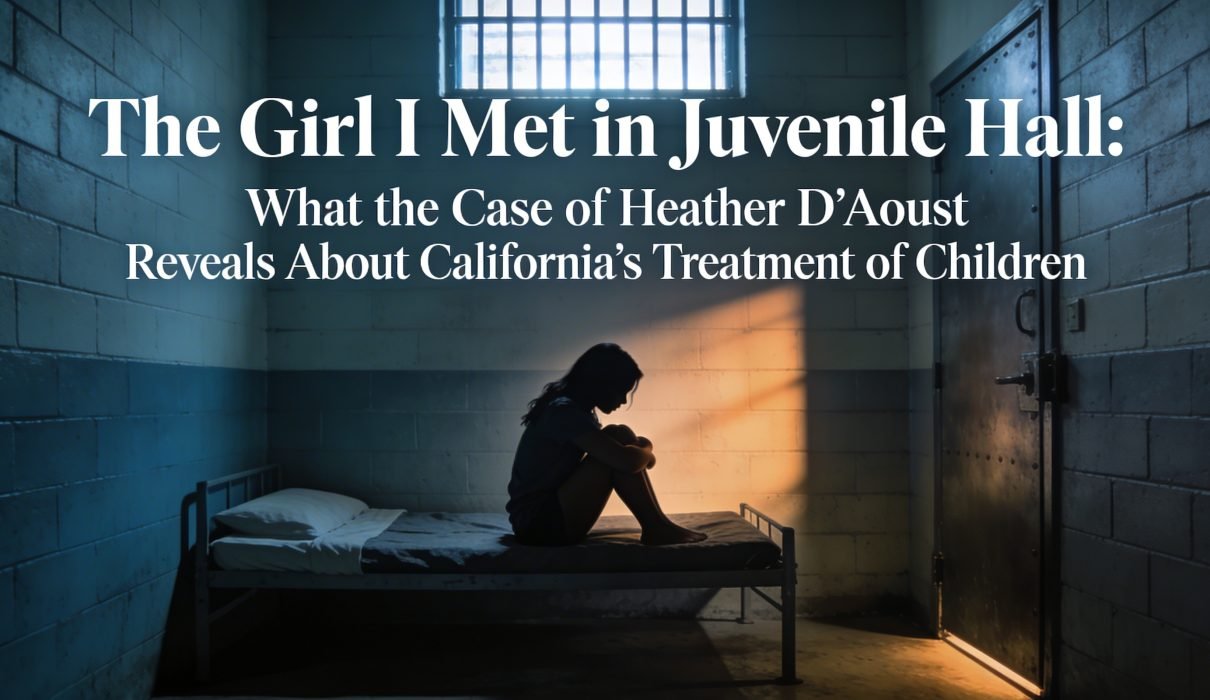
We were both kids navigating systems that were never built for children like us. We watched the inauguration of Barack Obama on a television bolted to the wall. We were marched into a multipurpose room to “exercise” to Sweatin’ to the Oldies with Richard Simmons — the only physical activity the facility offered at the time. And at night, in a building that had once been a mental institution, we felt the kind of eerie, unexplainable presence that every girl in that unit whispered about. The place was haunted in more ways than one.
But what I remember most is the way Heather told her story.
A Childhood Marked by Instability
Heather shared pieces of her life with me in the quiet moments — during meals, during downtime, during the long stretches when there was nothing to do but talk. She told me she was conceived while both her biological parents were institutionalized for severe mental illness. She told me she had been adopted by a family who tried to help her but struggled to understand the depth of her symptoms. She described nights when her mother sat outside her bedroom door until morning — a detail that spoke to fear, desperation, and a household overwhelmed by crisis.
These were her personal disclosures, not part of any public record. But they painted a picture of a child who needed intensive, long‑term psychiatric care from an early age. She didn’t get it.
I recognized the instability she described. I had lived my own version of it — mental health crises, adults who didn’t know what to do with a child in distress, a system that intervened only after the damage was done. When I looked at Heather, I saw a kid who had been drowning long before the state ever stepped in.
A Crime That Shocked a Community
In 2008, at age fourteen, Heather killed her adoptive mother. The act was brutal and irreversible. It devastated a family and reverberated across San Diego. Prosecutors charged her as an adult — a common practice in California at the time. She ultimately pleaded guilty to second‑degree murder and assault with a deadly weapon, receiving a sentence of 16 years to life.
During sentencing, the judge acknowledged that she suffered from significant mental health disorders. But under the laws of that era, those factors did not prevent her from being transferred into the adult system.
California’s Shifting Approach to Juvenile Justice
Heather’s case sits at a pivotal moment in California’s legal history. For decades, prosecutors had the power to “direct file” — to charge minors as adults without judicial review. Research eventually forced a reckoning:
- Adolescent brains are still developing.
- Impulse control and emotional regulation are not fully formed.
- Children respond to rehabilitation more effectively than adults.
- Adult prisons often worsen mental illness rather than treat it.
In the years after Heather’s sentencing, California passed reforms requiring judges — not prosecutors — to decide whether a minor should be tried as an adult. Legal experts have since noted that under today’s laws, a case like Heather’s would undergo far more scrutiny before a child was placed in the adult system.
Her story is not an anomaly. It is part of a broader pattern: children with untreated mental illness being punished for the symptoms adults failed to address.
The Woman She Is Becoming
Recently, I came across a piece of writing Heather published from prison. Her voice is different now — older, steadier, reflective. She writes with remorse, clarity, and a depth of self‑awareness that only years of reckoning can produce. It is the voice of someone who has spent a long time confronting the darkest moment of her life and trying to build something human in its aftermath.
Reading her words brought me back to the girl I knew — the one who sat beside me in juvenile hall, who shared her story with a trembling honesty, who was still very much a child.
I think about her often. And soon, I’ll be writing to her.
Why Her Story Still Matters
I’m publishing this because Heather’s life — before, during, and after the crime — raises questions we still haven’t answered:
- What happens when a child’s mental illness goes untreated?
- What responsibility does the state have to intervene early?
- What does justice look like for a child who commits an irreversible act?
- How many tragedies could be prevented with proper mental health care?
Heather’s case is not just about a crime. It’s about the systems that failed long before that night. It’s about the children who fall through the cracks. It’s about the possibility of transformation, even after the worst thing has already happened.
And it’s about remembering that behind every headline is a human being — one who was once a child.