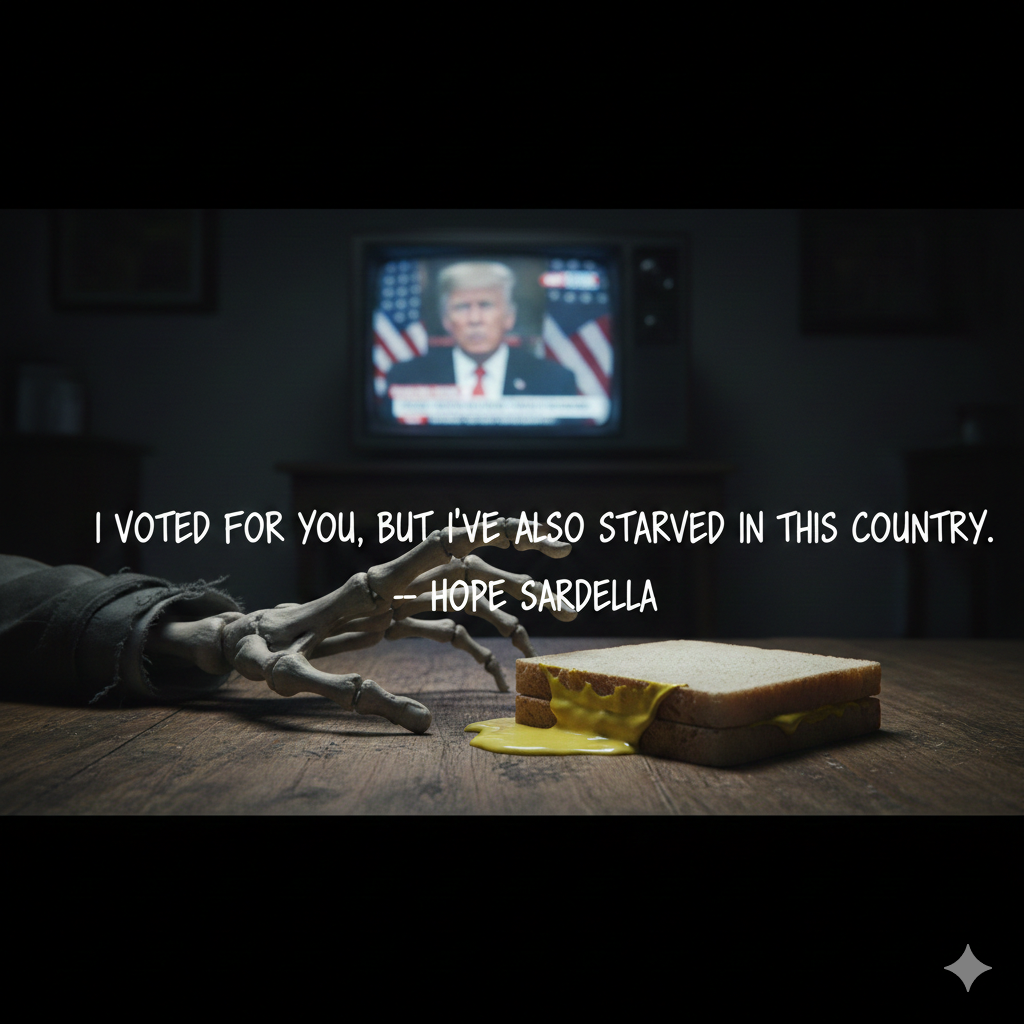
By Hope Sardella
President Trump,
I am writing this as someone who voted for you. I am writing as someone who believed you would fight for working people, struggling people, forgotten people. I am writing as someone who has known real hunger in this country — the kind of hunger many Americans insist doesn’t exist.
When I was a young girl, my mother left. She broke up with my stepdad and left me behind with him. We didn’t have much — not money, not stability, and definitely not food. I remember opening the refrigerator and seeing almost nothing. I remember making mustard sandwiches because that was all we had. Two slices of bread and a smear of mustard. That was dinner. That was survival.
Hunger at that age teaches you to be quiet. It teaches you to make yourself small. It teaches you to pretend you’re full so the adults don’t worry, or so they don’t get angry, or so you don’t feel the shame of needing something they can’t give.
Years later, it happened again. I was pregnant with my son — though I didn’t know it yet — and I was starving. I walked into a store and picked up a carton of eggs. I thought about slipping them into my bag. I thought about how badly I needed food. But I was too scared to steal. So I put the eggs back and walked out hungry.
That kind of hunger stays with you. Even when life gets better — and it has gotten better for me — the memory never leaves. I’m in college now. I have income. I’m building a future. But I haven’t forgotten what it felt like to be hungry in a country that claims hunger is impossible.
And that’s why I’m writing to you now.
Hunger Is Not a Myth. It’s a Policy Outcome.
SNAP used to be a lifeline. Imperfect, yes — but reachable. Now, the rules have tightened so much that the poorest people are being squeezed out of the very program designed to keep them alive.
Here’s the new reality many Americans don’t see:
– Work requirements have expanded to older adults, pushing people in their 50s and early 60s into mandatory employment just to qualify for food.
– If you don’t work enough hours, you lose SNAP.
– If you do work enough hours, you often earn “too much” to qualify.
– And the wages you earn still aren’t enough to buy groceries.
It is a perfect Catch‑22.
You have to work to get SNAP.
But if you work, you lose SNAP.
And the money you make isn’t enough to feed you.
People who have never been hungry don’t understand how cruel that is. But I do. I lived it. And millions of Americans are living it right now.
Why I’m Speaking Up
I voted for you because I believed you would help people like me — people who have struggled, people who have worked hard, people who have gone hungry and kept going anyway. But these SNAP policies are not helping us. They are hurting us.
I am asking you, respectfully and directly, to reconsider these changes. To look at the real lives behind the numbers. To understand that hunger is not a political talking point — it is a reality for people who are doing everything they can to survive.
I am not starving anymore. But there are people who are. And they deserve a government that sees them, hears them, and protects them.
Respectfully,
Hope Sardella
Tulsa, Oklahoma

By Hope Sardella
President Trump,
I am writing this as someone who voted for you. I am writing as someone who believed you would fight for working people, struggling people, forgotten people. I am writing as someone who has known real hunger in this country — the kind of hunger many Americans insist doesn’t exist.
When I was a young girl, my mother left. She broke up with my stepdad and left me behind with him. We didn’t have much — not money, not stability, and definitely not food. I remember opening the refrigerator and seeing almost nothing. I remember making mustard sandwiches because that was all we had. Two slices of bread and a smear of mustard. That was dinner. That was survival.
Hunger at that age teaches you to be quiet. It teaches you to make yourself small. It teaches you to pretend you’re full so the adults don’t worry, or so they don’t get angry, or so you don’t feel the shame of needing something they can’t give.
Years later, it happened again. I was pregnant with my son — though I didn’t know it yet — and I was starving. I walked into a store and picked up a carton of eggs. I thought about slipping them into my bag. I thought about how badly I needed food. But I was too scared to steal. So I put the eggs back and walked out hungry.
That kind of hunger stays with you. Even when life gets better — and it has gotten better for me — the memory never leaves. I’m in college now. I have income. I’m building a future. But I haven’t forgotten what it felt like to be hungry in a country that claims hunger is impossible.
And that’s why I’m writing to you now.
Hunger Is Not a Myth. It’s a Policy Outcome.
SNAP used to be a lifeline. Imperfect, yes — but reachable. Now, the rules have tightened so much that the poorest people are being squeezed out of the very program designed to keep them alive.
Here’s the new reality many Americans don’t see:
– Work requirements have expanded to older adults, pushing people in their 50s and early 60s into mandatory employment just to qualify for food.
– If you don’t work enough hours, you lose SNAP.
– If you do work enough hours, you often earn “too much” to qualify.
– And the wages you earn still aren’t enough to buy groceries.
It is a perfect Catch‑22.
You have to work to get SNAP.
But if you work, you lose SNAP.
And the money you make isn’t enough to feed you.
People who have never been hungry don’t understand how cruel that is. But I do. I lived it. And millions of Americans are living it right now.
Why I’m Speaking Up
I voted for you because I believed you would help people like me — people who have struggled, people who have worked hard, people who have gone hungry and kept going anyway. But these SNAP policies are not helping us. They are hurting us.
I am asking you, respectfully and directly, to reconsider these changes. To look at the real lives behind the numbers. To understand that hunger is not a political talking point — it is a reality for people who are doing everything they can to survive.
I am not starving anymore. But there are people who are. And they deserve a government that sees them, hears them, and protects them.
Respectfully,
Hope Sardella
Tulsa, Oklahoma
When Did Selling Ourselves Become Normal? Millennials, Gen Z, and the Blurred Line Between Art, Autonomy, and Online Exploitation
Republicans Are Daring Oklahoma to Vote Blue — And It Might Work